Annual Reports
Qfin Holdings, Inc.'s annual reports contain management's most considered account of the business. These are the sections, passages and visual pages worth opening in the originals preserved in Sources.
Qfin Holdings, Inc. — FY2025 Annual Report (Form 20-F) — FY2025
Management's fullest account of an AI credit platform that bears the loans' credit risk — VIE structure, the risk engine, asset quality, and the guarantee model. · Open the full document →
Item 3. Key Information — Our Holding Company Structure and Contractual Arrangements with the VIEs — p. 9 · Read the full section →
What ADS holders actually own: a Cayman shell that controls its China business only by contract, where the VIEs booked 96% of 2025 revenue.
Item 3.D. Risk Factors — Risks Related to Our Business and Industry — p. 28 · Read the full section →
The two company-specific risks that can actually bite: a consumer-credit book never tested through a full cycle, and regulatory caps on loan pricing.
Fees above the 24% private-lending limit are unenforceable; above 36% they are invalid.
in the event that the sum of the annualized interest that lenders charge and the fees we and our financia institution partners charge exceeds the 24% limit, and borrowers refused to pay the portion that exceeds the 24% limit, PRC courts would not uphold our request to demand the portion of the fees that exceeds the 24% limit from such borrowers. If the sum of the annualized interest that lenders charge and the fees we and our financial institution partners charge exceeds 36%, the portion that exceeds the 36% limit is invalid.
p. 34 · Read in context →
Item 4. B. Business Overview — p. 89 · Read the full section →
How Qifu makes money — credit-driven services (where it bears credit risk) versus capital-light platform services, with three years of volume and balance mix.
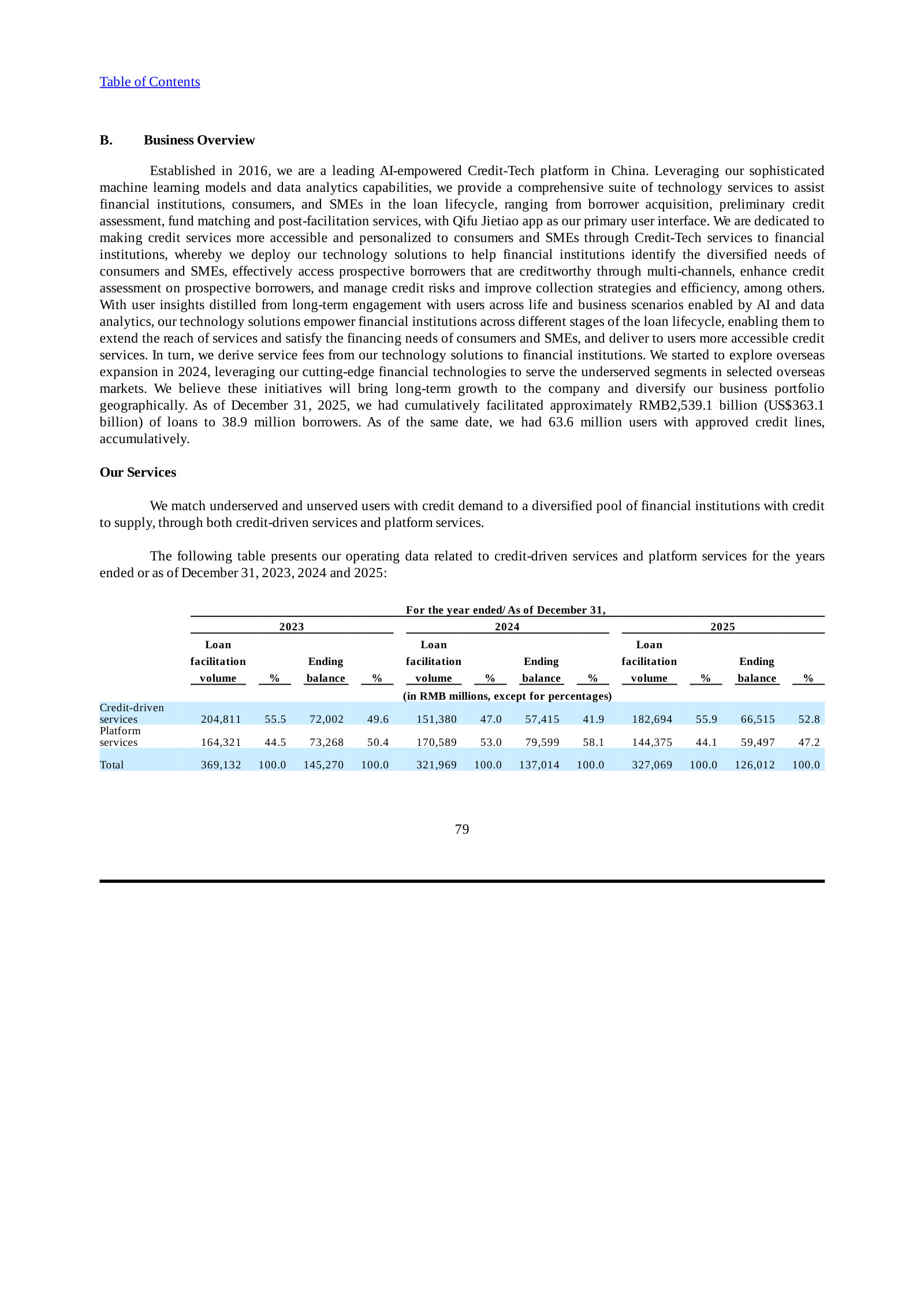
Under credit-driven services the company bears credit risk and guarantees financial-institution loans against default.
Under the credit-driven services category, we match prospective borrowers with financial institutions and empower financial institutions in borrower acquisition, credit assessment, fund matching and post-facilitation services. […] In both cases, we bear credit risks of the loans. For loans extended by our financial institution partners, we provide guarantees against potential defaults.
p. 90 · Read in context →
Item 4. B. Business Overview — Credit Assessment — p. 97 · Read the full section →
The Argus Engine — the machine-learning risk and anti-fraud engine that is the platform's core competitive claim.
Item 5. Operating and Financial Review — Loan Performance and On/Off-Balance Sheet Treatment of Loans — p. 137 · Read the full section →
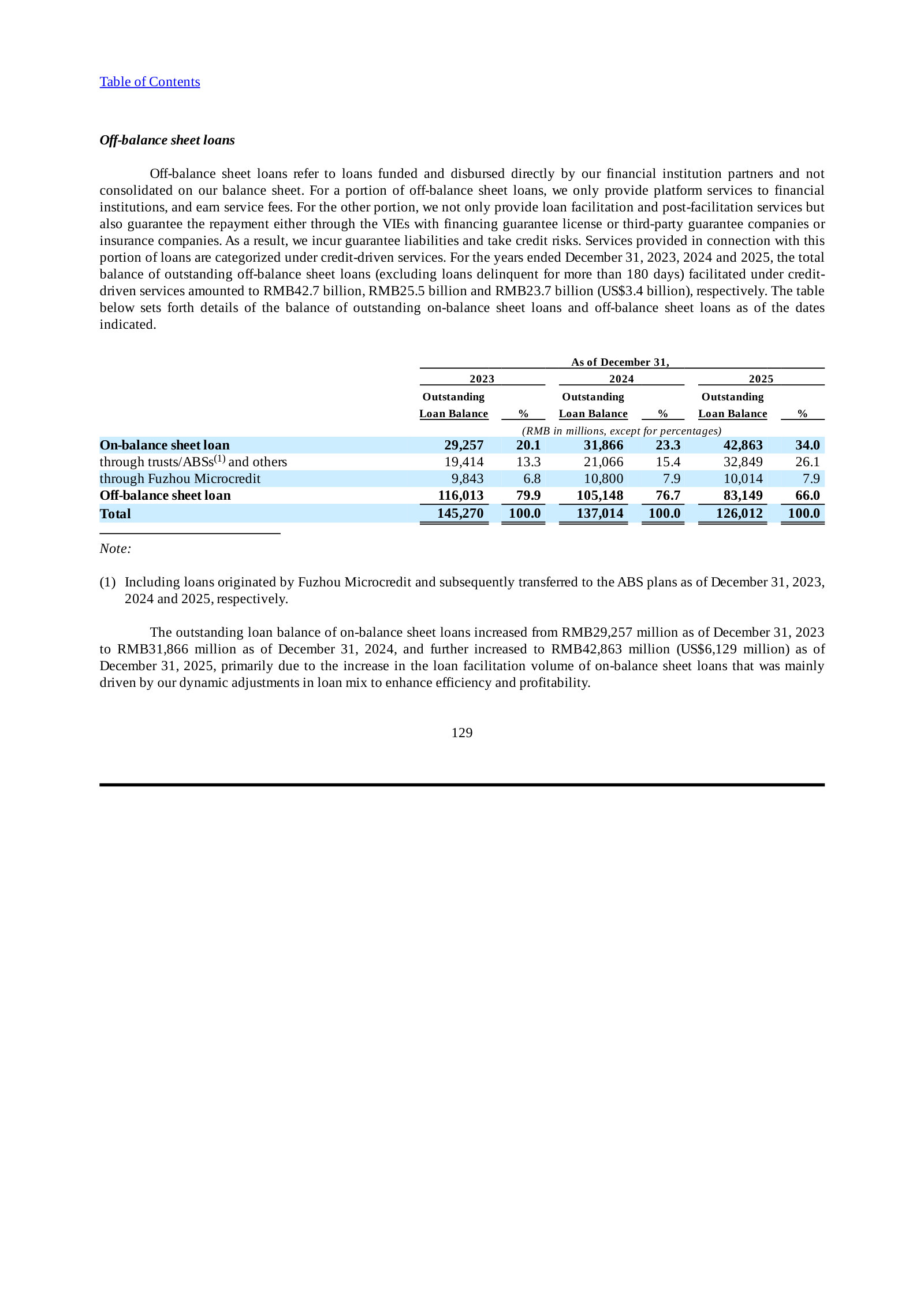
Where management explains asset quality — the 90-day+ delinquency uptick under 2025 rate caps — and how loans land on or off the balance sheet.
90-day+ delinquency rose to 2.71% in 2025 amid interest-rate caps and industry-wide liquidity tightening.
The overall 90 day+ delinquency rate increased from 2.09% as of December 31, 2024 to 2.71% as of December 31, 2025, primarily due to macroeconomic uncertainties and recent regulatory changes in China. Since April 2025, regulators have issued a series of measures targeting the consumer finance industry, including interest rate caps, which have contributed to a broader industry-wide liquidity tightening, particularly in the second half of 2025.
p. 137 · Read in context →
Item 5. Operating and Financial Review — Results of Operations — p. 146 · Read the full section →
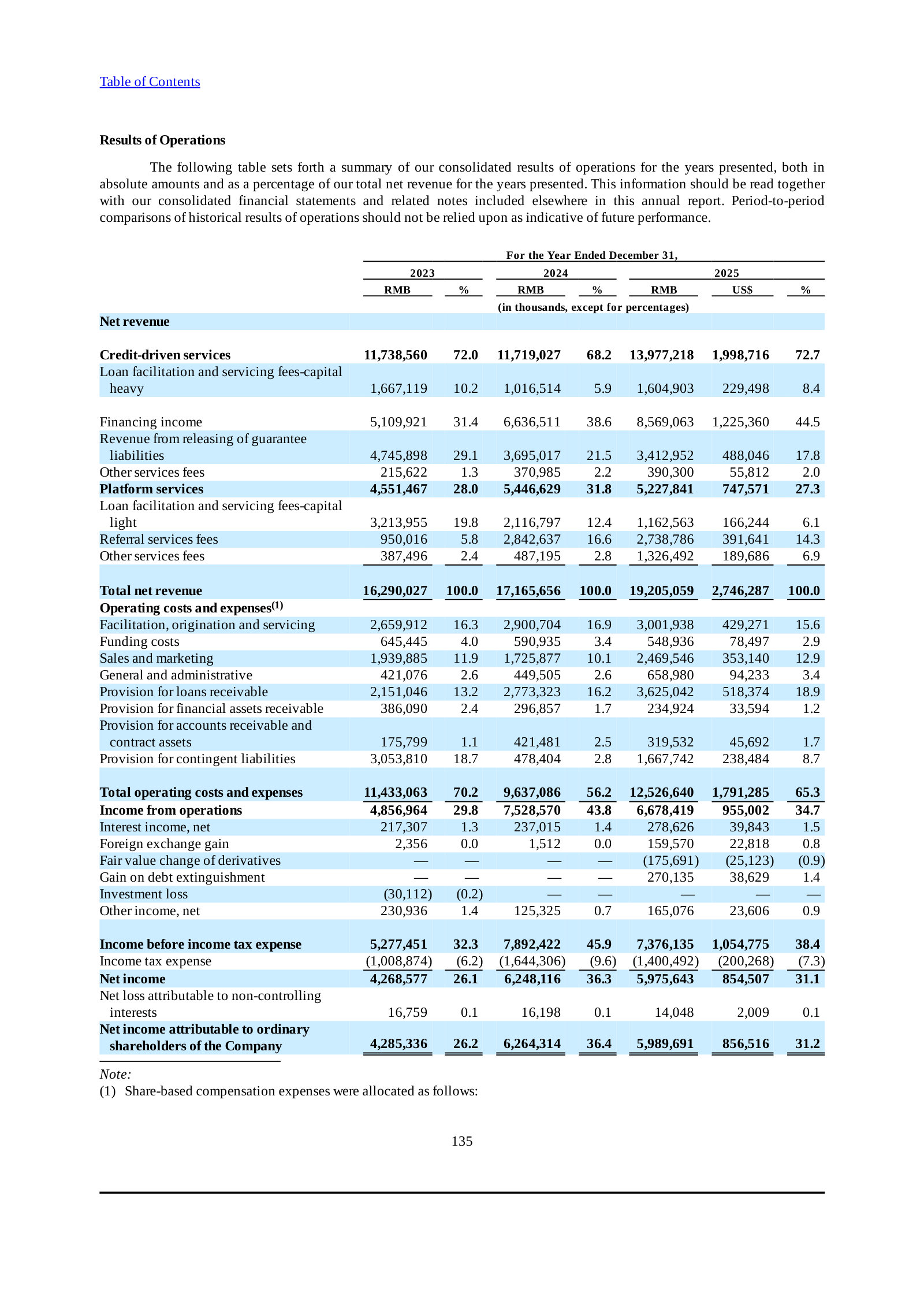
The revenue-mix and profitability bridge: credit-driven vs. platform revenue, provisions, and net income across 2023–2025.
Item 5.E. Critical Accounting Estimates — Guarantee Liabilities — p. 155 · Read the full section →
The accounting that defines the business model: because Qifu guarantees off-balance-sheet loans, a stand-ready guarantee liability sits at the center of its economics.
Guarantees on off-balance-sheet loans are booked as a fair-value stand-ready liability driven by estimated default rates.
For off-balance sheet loans facilitated where we effectively take on the credit risk of the borrowers through providing guarantee directly or cooperating with third-party licensed vendors including financing guarantee companies and insurance companies to provide guarantee, we recognize a stand ready guarantee liability at fair value. The fair value of stand ready guarantee liability is estimated using discounted cash flow model based on expected net payouts by incorporating a markup margin.
p. 157 · Read in context →
More annual reports
Qifu Technology, Inc. — FY2024 Annual Report (Form 20-F) — FY2024 · 331 pages · Filed as Qifu Technology (pre-rename); first edition to disclose the 2024 start of overseas expansion. · Open →
Qifu Technology, Inc. — FY2023 Annual Report (Form 20-F) — FY2023 · 286 pages · Captures the risk-tightening in 2H2023 that drove delinquency down to 2.35%, the low the 2025 report benchmarks against. · Open →
Qifu Technology, Inc. — FY2022 Annual Report (Form 20-F) — FY2022 · 420 pages · First edition under the Qifu Technology name (rebranded from 360 DigiTech), spanning the post-crackdown reset. · Open →
360 DigiTech, Inc. — FY2021 Annual Report (Form 20-F) — FY2021 · 223 pages · Earliest edition on the shelf, filed under the original 360 DigiTech name during China's fintech regulatory overhaul. · Open →